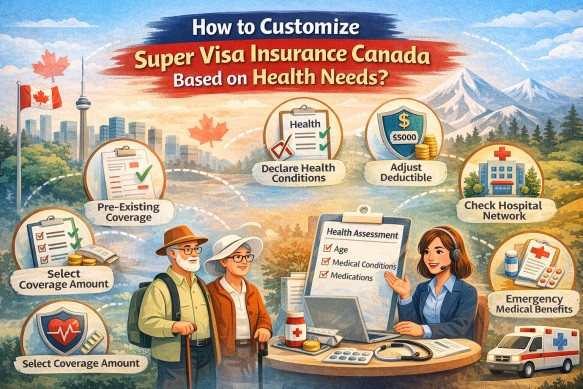
Choosing Super Visa Insurance is about more than simply finding a policy that meets the basic requirements. The deductible can make a noticeable difference to the premium you pay and the amount you may need to pay yourself if a covered medical claim occurs. Understanding this balance can help families choose coverage that fits both their budget and comfort level.
IRCC requires Super Visa applicants to have private health insurance valid for at least one year from the date of entry, with a minimum of $100,000 in emergency coverage for health care, hospitalization and repatriation.
What Is a Deductible in Super Visa Insurance?
A deductible is the amount you agree to pay toward an eligible insurance claim before the insurer pays the remaining covered expenses, subject to the policy’s terms, limits and exclusions. For example, if your policy has a $1,000 deductible and you have an eligible $8,000 medical claim, you may be responsible for the first $1,000, while the insurer covers the eligible balance according to the policy.
Deductibles can vary between insurance providers and policies. Some plans may offer a $0 deductible, while others provide higher deductible options. The important point is that the deductible is not the same as your premium. The premium is what you pay to purchase the insurance policy, whereas the deductible is generally an amount you may pay when an eligible claim occurs.
How Does a Deductible Affect Your Premium?
The deductible is one factor that can influence the cost of Super Visa Insurance. Generally, selecting a higher deductible can result in a lower premium because you are agreeing to take on a larger portion of the financial responsibility if a covered claim occurs. Conversely, a lower deductible generally means a higher premium.
For example, imagine two otherwise similar policies. One has no deductible, while another has a $1,000 deductible. The policy with the higher deductible may cost less upfront, but you would need to be prepared to pay the deductible if an applicable claim arises.
This is why looking only for the cheapest super visa insurance may not tell you the whole story. A lower premium can be attractive, but it is important to understand what deductible, coverage limits, exclusions and other conditions come with that price.
Choosing the Right Deductible for Your Budget
When comparing policies, consider how much you could comfortably pay if your parent or grandparent needed emergency medical treatment. Saving on the annual premium may make sense if you have enough funds available to handle the selected deductible. However, choosing a deductible simply because it produces the lowest premium may leave you with a larger unexpected expense later.
It is also worth comparing policies with the same coverage amount and similar terms. A $100,000 policy with one deductible cannot always be compared fairly with a different policy that has a different coverage limit or different conditions.
For families looking for the cheapest super visa insurance, comparing the complete policy rather than just the quoted premium is especially important. Age, coverage amount, medical history, policy duration and deductible can all affect pricing, so there is no single premium that applies to every applicant.
Deductible vs Premium: What Should You Consider?
Before choosing a deductible, look at your overall financial situation. Ask yourself how much you could comfortably pay out of pocket during a medical emergency. If a higher deductible would create financial pressure, paying a somewhat higher premium for a lower deductible may provide greater predictability.
Also check how the deductible applies under the specific policy. Some policy documents state that a deductible applies to each claim, so you should not assume that paying one deductible automatically covers every future claim. The exact wording in the insurance contract determines how the deductible works.
It is also important to remember that meeting the deductible does not mean every medical expense will automatically be covered. Policies can have exclusions, limitations, eligibility requirements and maximum coverage amounts. Reading the policy wording before purchasing can help prevent unpleasant surprises.
The goal should therefore be to find a balance between the premium you can afford and the out-of-pocket amount you could manage if a claim occurs. In other words, cheapest super visa insurance is not necessarily the policy with the smallest initial price; the overall value depends on the coverage and terms included.
Compare Before You Buy
A quote can be a useful starting point, but it should not be the only factor in your decision. Compare the deductible alongside the coverage limit, emergency benefits, exclusions, eligibility conditions and refund provisions.
For Super Visa applicants, the policy must meet IRCC’s requirements, including at least $100,000 in emergency medical coverage and a minimum one-year validity from the date of entry.
If you are comparing options, ask the insurer or broker to show how changing the deductible affects the premium. Seeing different deductible options side by side can make the cost difference easier to understand and help you decide what level of out-of-pocket responsibility is reasonable for your family.
FAQs
- Does a higher deductible lower Super Visa Insurance premiums?
Generally, yes. A higher deductible can lower the premium because you agree to pay more toward an eligible claim before insurance benefits apply. The exact savings depend on the insurer and policy. - Is a $0 deductible always the best option?
Not necessarily. A $0 deductible may provide less out-of-pocket responsibility when an eligible claim occurs, but it can come with a higher premium. Compare both costs before choosing. - Can I choose my Super Visa Insurance deductible?
Many insurers offer different deductible options, but the choices vary by provider and policy. Ask for quotes with multiple deductible levels to compare the premium difference. - Does the deductible affect whether my policy meets Super Visa requirements?
The deductible itself does not replace the required coverage. IRCC requires qualifying private health insurance with at least $100,000 in emergency coverage and other specified conditions. - How can I find the cheapest super visa insurance?
Compare quotes based on the same coverage amount, policy duration and deductible. Also review exclusions and conditions rather than comparing premiums alone, since the lowest quote may not provide the terms you need.
Meta title: Cheapest Super Visa Insurance: How Deductibles Affect Premiums
Meta description: Learn how Super Visa Insurance deductibles affect premiums, out-of-pocket costs and coverage choices, so you can compare plans with greater confidence.
For personalised guidance, Parent Super Visa Insurance Company can help you compare suitable Super Visa Insurance options, deductibles and coverage based on your family’s needs. Get a quote and review your options before purchasing.